Background

Publications
1. Hicks, J.W. and Badeer, H.S. (1989) Siphon mechanism in collapsible tubes: Application to circulation of the giraffe head. Amer. J. Physiol. 256:R567-R571
2. Badeer, H.S and Hicks, J.W. (1990) The role of viscous resistance in siphon flow. The Physics Teacher, 8: 558-559
3. Hicks, J.W. and Badeer, H.S. (1992) Gravity and the Circulation: Open vs. Closed Systems; An Invited Opinion. Am. J. Physiol. 31: R725-R732
4. Badeer, H.S. and Hicks, J.W. (1992) The hemodynamics of the vascular waterfall: Is the analogy justified?. Respir. Physiol. 87: 205-217
5. Badeer, H.S and Hicks, JW (1994) Pitfalls of assessment of vascular resistance. Cardiology 85:23-27
6. Caiozzo, V.J., C. Rose-Gottron, K.M. Baldwin, D. Cooper, G. Adams, J. Hicks, and A. Kreitenberg (2004) Hemodynamic and metabolic responses to hypergravity on a human powered centrifuge. Aviation Space and Environmental Medicine Feb;75(2):101-8.
Exposure to microgravity (i.e. spaceflight) results in several changes in cardiovascular function that include elevated venous compliance and heart rate, lowered blood volume, central venous pressure and stroke volume, cardiac atrophy and attenuated baroreflex function. These cardiovascular adaptations are not functionally apparent during spaceflight, but become dysfunctional for the astronauts upon return to a 1G environment, manifested as orthostatic intolerance (unable to stand continuously for 10 minutes) and up to a 25% reduction in maximal exercise capacity . Similar cardiovascular deconditioning is also observed during prolonged 6-degree head-down bed rest (i.e. simulated microgravity). A variety of countermeasures have been developed, including saline “loading”, intermittent venous pooling (lower body negative pressure; LBNP), pharmacological manipulations and resistance training, but have had only limited success .
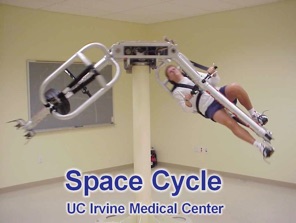
The proposed research will investigate the importance of acceleration in exercise training and cardiovascular function using a unique countermeasure device known as the "Space Cycle". The Space Cycle is a self-powered human centrifuge (Figure 1) that has a radius of 6 feet and is compatible with the dimensions of Space Station. The titanium frame houses a drive system and restraints for riders and is configured so that the legs are required to produce power. The head is supported in a neutral position by a headrest, and the torso is supported by a bicycle seat and backrest support. A SPD binding type shoe pedal clip system fixes and protects the feet during Space Cycle activity. The physiological instrumentation of the Space Cycle includes monitors for blood pressure, heart rate, and oxygen consumption. Work and power are controlled using an electromagnetically braked ergometer. The Space Cycle allows subjects to exercise at intensities that range from <10% to >100% VO2 max under a variety of G-forces .
Gravitational Physiology