Background

Cardiovascular Shunts
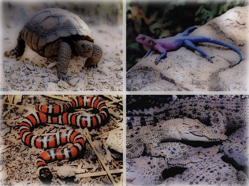
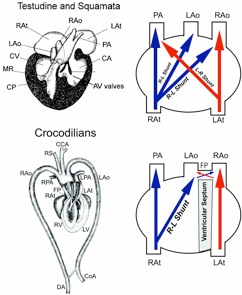
The evolution of the vertebrate heart can be portrayed as a continuous progression from the two-chambered heart of fish to the completely divided, four chambered heart of birds and mammals. Historically, the incompletely divided ventricle of non-crocodilian reptiles and the resulting central mixing of oxygen rich and oxygen poor blood (cardiac shunting) was viewed as an intermediate phylogenetic step that was functionally inefficient compared to the circulation of "higher" vertebrates. This perception changed during the last several decades when several studies showed that the degree of mixing within the reptilian heart is influenced by the ventilatory state of the animal and is probably regulated. The ability to control cardiac shunts is hypothesized to provided several unique physiological advantageous to reptiles, however experimental support for these advantages is lacking. We use a variety of approaches, including acute in situ and chronic in vivo preparations as well as modeling to study the cardiovascular system of reptiles. Our goal is to understand the role of the autonomic nervous system in orchestrating the suite of cardiopulmonary responses during a variety of physiological states, including exercise, temperature regulation, digestion, diving and respiration. Ultimately we want to gain insights into the physiological functions of this unique anatomical "design".

1. Wood, S.C. and J.W. Hicks (1985). Oxygen homeostasis in vertebrates with cardiovascular shunts. In: Alfred Benzon Symposium: Cardiovascular shunts: Phylogenetic, ontogenetic, and clinical aspects. ed. by K. Johansen and W. Burggren, Munksgaard, Copenhagen. pp 354 -367
2. Ishimatsu, A., J.W. Hicks and N. Heisler (1987) Analysis of intracardiac shunting in the lizard, Varanus niloticus: A new model based on blood oxygen levels and microsphere distribution. Respir. Physiol. 71:83-100.
3. White, F.N. and J.W. Hicks (1987) Cardiovascular implications of the transition from aquatic to aerial respiration. In: Comparative Physiology: Life in Water and on Land. Edited by P. Dejours, L. Bolis, C.R. Taylor and E.R. Weibel. Fidia Research Series, Padova, Liviana Press, pp. 93-106.
4. White, F.N., Hicks, J.W. and Ishimatsu, A. (1989) Respiratory states and intracardiac shunts in turtles, Amer. J. Physiol. 256: R240-R247
5. Hicks, J.W. and S.C. Wood (1989) Oxygen homeostasis in lower vertebrates: The impact of external and internal hypoxia. In: Lung Biology in Health and Disease- Comparative Pulmonary Physiology: Current Concepts. ed by S.C. Wood, Marcel Dekker, New York, pg. 311-341.
6. Hicks, J.W. and Malvin, G.M. (1992) Mechanism of intracardiac shunting in Pseudemys scripta. Am. J. Physiol., 262:R986-R992
7. Hicks, J.W. and White, F.N. (1992) Ventilation and gas exchange during intermittent ventilation in the American alligator, Alligator mississipiensis. Respir. Physiol. 88: 23-36
8. Hicks, J.W. (1993) Regulation of Intracardiac Shunting in Reptiles: Anatomic vs Effective Shunting. In: The Vertebrate Gas Transport Cascade: Adaptations to Environment and Mode of Life. edited by J.E. Bicudo and M.L. Glass, CRC Press, pg 252-265
9. Hicks, J.W.(1993) Mechanism of Intracardiac Shunting in Reptiles In: Respiration in Health and Disease, Lessons from comparative Physiology., Academie der Wissenschaften und der Literatur, Funktionsanalyse biologischer Systeme, edited by Peter Scheid, Gustav Fischer Verlag, Stuttgart, 23, 249-259
10. Hicks, J.W (1994) Adrenergic and cholinergic regulation of intracardiac shunting. Physiol. Zool. 67(6):1325-1346
11. Hicks, J.W. and Comeau, S.G. (1994) Vagal regulation of intracardiac shunting in the turtle, Pseudemys scripta. J. exp. Biol., 186, 109-126
12. Comeau, S.G.and Hicks, J.W. (1994) Regulation of central vascular blood flow in the turtle.Am J Physiol.267: R569-R578
13. Hicks, J.W. and Malvin, G.M. (1995) Mechanism of Intracardiac Shunting in Reptiles: Pressure vs.Washout Shunting. In: Advances in Comparative and Environmental Physiology, Mechanisms of Systemic Regulation: Vol I., Respiration and Circulation (Volume Editor, N. Heisler ), Springer-Verlag pg. 137-157
14. Hicks, J.W. and Wang, T. (1996) The functional role of cardiac shunting in reptiles. J. exp. Zool. 275:204-216
15. Malvin, G.M., Hicks, J.W. and Greene, D. (1995) Central vascular blood flow patterns in the alligator, Alligator mississippiensis. Am. J. Physiol. 38:R1133-R1139
16. Hicks, J.W., Ishimatsu, A., Molloi, S., Erashin, A. and Heisler, N. (1996) The mechanism of cardiac shunting in reptiles: A new synthesis. J. exp. Biol. 199:1435-1446
17. Ishimatsu, A., Hicks, J. W. and Heisler, N. (1996) Analysis of cardiac shunting in the turtle Trachemys (Pseudemys) scripta: application of the three outflow vessel model J. Exp. Biol. 199.12 2667-2677
18. Wang, T. and Hicks, J.W. (1996) The interaction of pulmonary ventilation and the right-to-left shunt on arterial oxygen levels. J. exp. Biol.199:2121-2129
19. Wang, T. and Hicks, J.W. (1996) Cardiorespiratory synchrony in turtles. J. exp. Biol. 199: 1791-1800
20. Hicks, J.W. and Krosniunas, E.H. (1996) Physiological states and intracardiac shunting in non-crocodilian reptiles. Exp. Biol. Online 1: 3, http://science.springer.de/EBO/tocs/t96.htm
21. Wang, T., Krosniunas, E.H. and Hicks, J.W. (1997) The role of cardiac shunts in the regulation of arterial blood gases. Am. Zool. 37: 12-22.
22. Hicks, J.W. and Wang, T. (1998) Cardiovascular regulation during anoxia in the turtle: an in vivo study. Physiol. Zool. Jan-Feb, 71(1):1-14.
23. Hicks, J.W. (1998) Cardiac Shunting in Reptiles: Mechanisms, Regulation and Physiological Function. In: Biology of the Reptilia, vol. G., The Visceral Organs (ed. C. Gans and A.S. Gaunt). Ithaca, NY., Society for the Study of Amphibians and Reptiles. Pg. 425-483
24. Wang, T. and Hicks, J.W. (2000) An Integrative model to predict maximum O2 uptake in animals with central vascular shunts. Zoology- Analysis of Complex systems (in press)
25. Platzack B, Hicks JW. (2001) Reductions in systemic oxygen delivery induce a hypometabolic state in the turtle Trachemys scripta. Am J Physiol Regul Integr Comp Physiol. 2001 Oct;281(4):R1295-301.
26. Platzack B, Wang Y, Crossley D, Lance V, Hicks JW, Conlon JM. (2002) Characterization and cardiovascular actions of endothelin-1 and endothelin-3 from the American alligator.
Am J Physiol Regul Integr Comp Physiol. 2002 Feb;282(2):R594-602.
27. Hicks JW. (2002)The physiological and evolutionary significance of cardiovascular shunting patterns in reptiles. News Physiol Sci. 2002 Dec;17:241-5. Review
28. Crossley DA 2nd, Hicks JW, Altimiras J. (2003) Ontogeny of baroreflex control in the American alligator Alligator mississippiensis.J Exp Biol. 2003 Aug;206(Pt 16):2895-902.
29. Krosniunas EH, Hicks JW. (2003) Cardiac output and shunt during voluntary activity at different temperatures in the turtle, Trachemys scripta. Physiol Biochem Zool. 2003 Sep-Oct;76(5):679-94.